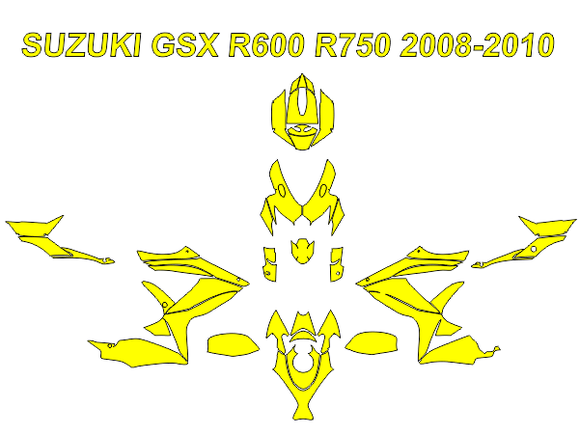
Sportbike Graphics Templates
SPORTBIKE // Fairing Graphics Templates
Yamaha R · Honda CBR · Kawasaki ZX · Suzuki GSX-R · Ducati · BMW · Every Year. Every Restyle.
The complete sportbike fairing template catalog — every Yamaha R-series, Honda CBR, Kawasaki Ninja ZX, Suzuki GSX-R, Ducati Panigale, BMW S1000RR, and Aprilia RSV4 across every production year and restyle configuration we carry. OEM-accurate plastic geometry. Clean layers. Closed paths. Set bleed zones. Built for MX graphics designers, print shops, and wrap studios who don't have time to re-trace panels that already exist.
Every fairing panel mapped to exact factory bodywork — upper fairings, belly pans, winglets, tail sections. Verified dimensions, not tracings.
Closed contours, set bleed, labeled layers. Straight from file to RIP or plotter. Zero cleanup, zero prep time.
Single-use commercial license. No resale, no redistribution, no sharing. KrazyGraphics intellectual property.
Adobe Illustrator, CorelDRAW, Inkscape, Affinity Designer. GraphTec, Roland, Summa plotters. No lock-in.
Full Sportbike Template Guide · Model Coverage · Technical Docs
The Complete Sportbike Fairing Template Catalog
The KrazyGraphics sportbike template library is the deepest multi-brand vector fairing template collection built specifically for track-day riders, race teams, livery designers, and wrap studios working in the supersport and superbike categories. Every major platform — Yamaha R-series, Honda CBR, Kawasaki Ninja ZX, Suzuki GSX-R, Ducati Panigale, BMW S1000RR, Aprilia RSV4 — is mapped panel-by-panel to the exact OEM bodywork geometry for each generation and year. These are not generic sportbike outlines reskinned to look like they work on multiple brands. Every fairing template is built specifically for the bodywork it names, and the difference shows the moment you drop your first design onto the layout and watch it align perfectly with the factory panel seams instead of spilling past winglet edges or missing the tail section anchor points riders expect.
Sportbike livery designers, decal print shops, wrap studios, club racers, and privateer teams all rely on accurate templates to do their work. A wrong-year fairing template is worse than no template at all — it costs you paid print runs, wasted vinyl on a 1,000-dollar set of painted race bodywork, and customer trust. That's why every file in this catalog is verified against the real bike. If you need a template for a 2022 Yamaha R1, you get a template built for the 2022 Yamaha R1 — not a generic "2015 to 2024" approximation that kind-of-sort-of fits. Sportbike fairings change too often and too significantly for close-enough to work.
Yamaha R Platform — R1, R6, R3, R7
Yamaha's R-series supersports have defined the open-class and 600 supersport segments for over two decades. The R1 has gone through five major generations since 1998 — the original 1998–2001 carbureted era, the 2002–2003 fuel-injected chassis, the 2004–2006 refresh, the landmark crossplane-crank 2009–2014 generation, the 2015–2019 M1-inspired chassis, and the 2020-onward cyclopean Euro-5 bodywork. Each generation has its own fairing shape, winglet configuration, and tail section geometry. The R6 follows a parallel update cadence through 1999–2002, 2003–2005, 2006–2007, 2008–2016, and the final 2017–2020 generation before Yamaha pivoted the R6 to track-only. KrazyGraphics carries verified templates for every generation of both bikes.
The Yamaha R3 and R7 round out the smaller-displacement R-family. Both are popular track-day starter bikes and club-race platforms — the R3 especially dominates the MotoAmerica Junior Cup and twin-spec amateur racing classes, which means fairing templates for the R3 see massive volume through club race teams building season liveries. The R7 is the newest addition to the family and has rapidly taken over the middleweight twins class. Both have dedicated templates built to their specific bodywork.
Honda CBR Platform — CBR1000RR, CBR600RR
Honda's CBR1000RR and CBR600RR are the Red Rider answer to Yamaha's R-series — liter and 600 supersports that have been on the podium since the early 2000s. The CBR1000RR generation history is long: the 2004–2005 Fireblade, the 2006–2007 MotoGP-inspired chassis, the 2008–2011 C-ABS generation, the 2012–2016 update, the 2017–2019 chassis overhaul, the 2020–2023 CBR1000RR-R Fireblade SP with its aggressive winglet package, and the 2024-onward refresh. The CBR600RR has held a remarkably consistent design language across its generations but has had subtle fairing revisions that matter for graphics alignment.
The CBR1000RR-R Fireblade SP in particular is one of the most-requested sportbike fairing templates in the KrazyGraphics catalog because its aggressive winglets and tall side fairings create one of the most distinctive bodywork profiles in the liter-class segment. Getting the template right for that bike is essential — the winglets alone disqualify most generic templates from working.
Kawasaki Ninja Platform — ZX-10R, ZX-6R, ZX-4R
Kawasaki's ZX-10R has been the WSBK reference bike for the better part of a decade, and its fairing generations reflect a bike designed around championship-winning aerodynamics. The 2011–2015 chassis, the 2016–2020 championship platform, and the 2021-onward revised chassis each have distinct bodywork. The ZX-10RR variant adds additional winglet hardware that requires its own template revision. The ZX-6R remains one of the longest-running sportbikes on the market and has accumulated a decade-plus of generational changes that the KrazyGraphics catalog tracks individually.
The ZX-4R is a newer addition — Kawasaki's 400cc supersport entry bringing full-bodied sportbike styling to a 400-class chassis. Its fairing template has been added to the catalog to meet demand from club racers building entry-class race bikes and riders who want full sportbike aesthetics on a learner-friendly platform.
Suzuki GSX-R Platform — 1000, 750, 600
Suzuki's GSX-R line is the longest continuous sportbike platform in the industry, with the GSX-R name running since the 1985 GSX-R750. The modern era covers the K-series generations (K1 through K9 for the 600/750 and beyond), the 2009–2016 GSX-R1000, the 2017-onward GSX-R1000R with variable valve timing, and the iconic GSX-R750 that has remained largely unchanged since 2011. The KrazyGraphics GSX-R catalog covers modern generations back through the early 2000s — enough range to handle almost any GSX-R a customer rolls in with.
GSX-R fairings have a specific design language with sculpted sidepanel cuts and distinctive tail section geometry that requires model-specific templates. A K7 GSX-R600 template does not work on a K8 GSX-R600 even though the bodywork looks superficially similar — the side fairing cutouts are different, and that's visible in a finished livery if you use the wrong template.
European Platforms — Ducati, BMW, Aprilia
The European open-class superbikes represent the premium tier of the sportbike market and have their own distinct fairing conventions. Ducati Panigale — V4, V2, 1299, 1199, 899, and earlier 1098 generations — have some of the most sculptural bodywork in the industry, and their templates reflect that complexity. The V4 in particular has a distinctive winglet and side-vent arrangement that's essential for any factory-replica or custom livery to read correctly.
BMW S1000RR has gone through two major generations since 2009, plus the 2023 chassis refresh and the M1000RR homologation variant. The asymmetric face and M-package bodywork of the S1000RR make template accuracy particularly important — the headlight asymmetry is a signature BMW detail that liveries wrap around. Aprilia RSV4 and RS 660 round out the Italian lineup with their own dedicated templates reflecting Aprilia's aggressive chassis geometry and factory-WSBK design heritage.
What You Get With Every Sportbike Template
Every template file in this catalog ships with the same core structure and production standards. Opening a sportbike fairing template for the first time, you should expect to find:
- Full bodywork coverage — upper fairing, lower left fairing, lower right fairing, tail section, belly pan, tank cover, and front fender. Every visible external panel that takes graphics is represented.
- Labeled layer tree — every fairing panel is on its own clearly-named layer, so you can lock, hide, duplicate, or export individual panels without clicking through dozens of unlabeled layers to find what you want.
- Closed contour paths — every panel outline is a fully closed vector path, so your RIP software recognizes the boundary and your cutting plotter reads the contour correctly on the first pass.
- Set bleed zones — the bleed is pre-built into each fairing panel, so your finished graphics extend correctly past the visible edge and don't show white slivers after cutting.
- Alignment references — registration marks and panel-to-panel alignment references are placed where needed so graphics that cross the upper-to-lower fairing seam line up cleanly across the whole bike.
- Clean geometry — no stray points, no overlapping duplicate paths, no hidden leftover objects from earlier revisions. You open the file and it's production-ready.
Who This Catalog Is For
The sportbike template catalog is built for professionals and serious riders who need OEM-accurate base files to build liveries and graphics on top of. Specifically:
Race Team Livery Designers
Club race teams, MotoAmerica privateers, WERA competitors, and CCS regulars all need season liveries that look professional and align correctly across the fairing. A verified template library is the foundation of a livery design workflow — it's the difference between a team that looks like a real race program and a team running mismatched decal sets. Every hour a designer saves not tracing fairings is an hour spent on the actual livery concept.
Sportbike Graphics Designers and Livery Studios
If you design custom sportbike liveries as a service — selling finished kits to track-day riders and street riders through Instagram, Etsy, Facebook groups, or your own website — accurate base templates are your highest-leverage tool. A reliable sportbike template library means you can quote faster, deliver faster, and take on more clients without increasing your workload per kit. Sportbike customers are detail-obsessed and notice misalignment immediately.
Decal Print Shops and Wrap Studios
High-volume print shops producing sportbike graphics kits need templates that hit the plotter cleanly on the first run. Sportbike fairings are expensive — a wrong template on a customer's painted $2,500 Hotbodies bodywork kit is a disaster. Verified KrazyGraphics templates remove the geometry variable from your production process so you can focus on quality and turnaround.
Track-Day Riders and Privateer Racers
If you're building your own track bike livery — especially if you're converting to race bodywork and want a repaint that looks professional — having access to an OEM-accurate template lets you work directly with a designer remotely without needing to ship your bike anywhere for measurement. The template IS the measurement. This is particularly relevant for riders building factory-replica liveries (Yamaha Factory Monster Energy, Ducati Aruba, Kawasaki Racing Team, BMW M) where proportions have to be exactly right to read as authentic.
Software Compatibility and Workflow Notes
KrazyGraphics sportbike templates use standard vector formats with no proprietary layers, no embedded rasters, and no export dependencies. That means you can open any template in your tool of choice and get the same result:
- Adobe Illustrator — full compatibility, native file handling, all layers visible and editable immediately.
- CorelDRAW — standard import, all paths and layer names preserved.
- Inkscape — free and open-source option, handles all template files without plugin requirements.
- Affinity Designer — supported through standard vector import, layer names preserved.
- Any other vector app — if it reads industry-standard vector formats, it reads these templates.
On the output side, the template files are designed to hand off cleanly to every major print-and-cut plotter workflow: GraphTec cutting plotters, Roland printer-cutters, Summa contour cutters, Mimaki print-and-cut systems, and any other plotter that accepts standard vector path data with registration marks. There are no tool-specific file formats, no locked-in ecosystems.
Pricing, Licensing, and Digital Delivery
Every sportbike template in the catalog is a one-time digital purchase with a single-use commercial license. After checkout, your download is delivered instantly — no waiting for a shipment, no delay between payment and production. You own the license to use that template to produce livery designs for your own customers, sell those finished designs as printed decal sets or installed wraps, and build your own brand around the work you create on top of the base file.
The template file itself may not be resold, redistributed, shared with another business, or uploaded to template marketplaces. Each purchase covers a single production workflow — yours. This licensing model keeps pricing accessible for individual livery designers and small shops while protecting the template library from being resold as bootleg knockoffs on third-party sites. All templates are DMCA-protected KrazyGraphics intellectual property.
Because these are made-to-produce tools rather than consumer products, there are no returns on digital template downloads — the file is delivered instantly. If you have questions about whether a specific template will fit your project, reach out before ordering and we'll confirm fitment against your year and model.
How to Choose the Right Sportbike Template
The single biggest mistake sportbike template buyers make is ordering based on a close-enough year match. Sportbike fairings change too frequently and too significantly for cross-generation use. A 2014 R1 template will not work on a 2015 R1 because Yamaha completely redesigned the bodywork for the M1-inspired generation. A 2019 CBR1000RR template will not work on a 2020 CBR1000RR-R because Honda revised the entire fairing for the SP homologation model. Always match three things exactly:
- Model — R1, R6, CBR1000RR, CBR600RR, ZX-10R, GSX-R1000. Never substitute across models or across open-class versus middleweight.
- Year or year range — if the template lists "2015-2019," it covers those five years of stable bodywork. Using it on a 2020 bike is a risk because that's where the next generation likely started.
- Variant — standard, SP, RR, M, R — factory variant designations often ship with different bodywork, winglets, or tail sections. Always confirm variant before ordering.
When in doubt, check the product page images for each template — panel layouts are shown visually so you can verify the fairing shape, winglet profile, and tail geometry match the bike you're designing for before ordering.
Why KrazyGraphics for Sportbike Templates
The sportbike template market is a mix of high-quality professional libraries and questionable hobbyist tracings sold as professional product. The KrazyGraphics catalog stands apart on three specific fronts. First, the depth of multi-brand coverage — most template libraries specialize in one brand because the volume is easier to maintain, but real-world livery designers work across brands depending on their clients. Having Yamaha, Honda, Kawasaki, Suzuki, Ducati, BMW, and Aprilia all under one roof with the same production standards eliminates the need to cross-reference multiple template vendors.
Second, the file structure is production-grade. Too many sportbike template files in the wild are traced approximations with messy layer trees, open paths, stray objects, and missing bleed zones. Every sportbike template in this catalog is built to a consistent professional standard — clean layers, closed paths, set bleed, labeled panels, ready to work.
Third, the catalog is actively maintained. As manufacturers release new generations — the 2024 Yamaha R1 chassis, the 2025 Honda CBR1000RR-R update, the 2024 Ducati Panigale V4 refresh — new templates are added to reflect those changes. This isn't a static archive. It's a working professional library for people who make their living on accurate fairing files.
Start Designing
Browse the sportbike template catalog above by brand or model, or use the filters to narrow by generation and variant. Every product page shows the exact panel layout for that specific template so you can confirm fitment before checkout. Downloads are delivered instantly — purchase and open the file within seconds. If you need a sportbike template that isn't in the current catalog, contact KrazyGraphics directly for a custom build quote.
Common Questions About Sportbike Template Fitment
The most common support question we get from sportbike template buyers is whether a given template will work on a bike a year or two newer or older than specified. The honest answer: probably not. Sportbike bodywork revisions are aggressive and frequent — a single model year difference can mean a completely new fairing, a redesigned tail section, or added winglets. Always match the exact year and variant.
If you're designing for a bike that has been converted to aftermarket race bodywork — Sharkskinz, Hotbodies, Armor Bodies, CarbonVani, or similar — the OEM template will not match. Aftermarket race bodywork has its own geometry that's intentionally different from OEM to save weight, improve airflow, or provide better crash protection. For race bodywork conversions, look for the aftermarket-specific templates rather than relying on an OEM file.
Club race legality and liveries
Club racing organizations — MotoAmerica, WERA, CCS, AHRMA — all have their own livery and number-plate regulations. A template is just the geometry; the livery design on top of it is what has to satisfy the sanctioning body's requirements. Most race clubs require a specific number-plate location, minimum number size, and clear-area requirements around sponsor decals. Check your club's rulebook and design within those constraints using the template as your fairing guide.
Integration With Your Production Workflow
A verified sportbike template is only as valuable as how cleanly it integrates with the rest of your production pipeline. The files in this catalog are structured specifically to slot into standard sportbike livery workflows with minimum friction. In the design phase, open the template, add your design elements on top of the labeled panel layers, adjust colors and typography to match your client's requirements, and export for proofing. Most templates include a "design area" layer reference showing the visible surface of each fairing panel — you know exactly where graphics can and cannot be placed. Text that crosses fairing seams can be cleanly split using the template's closed contour paths as cutting guides.
In proofing, every panel on its own labeled layer means you can quickly export flat proofs for client approval — either as a single combined PDF showing the whole bike or as individual panel proofs. Multi-round proofing is faster when you aren't fighting disorganized layer trees every revision. In production, your finished design exports with the template's built-in bleed and registration marks intact, sends straight to RIP, and the plotter cuts clean contours on the first pass. At install, because the template geometry matches the actual fairing bodywork, cut graphics lay onto the bike cleanly with minimum stretching and no gaps along the fairing seams.
Sportbike template · sportbike fairing template · Yamaha R1 template · R6 template · R3 template · R7 template · Honda CBR1000RR template · CBR600RR template · Fireblade SP template · Kawasaki ZX-10R template · ZX-10RR template · ZX-6R template · ZX-4R template · Suzuki GSX-R1000 template · GSX-R750 template · GSX-R600 template · Ducati Panigale V4 template · Panigale V2 template · Panigale 1299 template · BMW S1000RR template · M1000RR template · Aprilia RSV4 template · RS 660 template · sportbike livery template · track bike template · race livery vector file · supersport template · superbike template · motorcycle fairing template · sportbike wrap template · sportbike decal template · upper fairing template · lower fairing template · tail section template · belly pan template · sportbike Illustrator template · sportbike CorelDRAW template · sportbike print and cut template · WSBK livery template · MotoAmerica livery template · club race livery template
FAQ · Sportbike Templates
What sportbikes are covered?
Every major platform — Yamaha R1, R6, R3, R7; Honda CBR1000RR, Fireblade SP, CBR600RR; Kawasaki ZX-10R, ZX-10RR, ZX-6R, ZX-4R; Suzuki GSX-R 1000/750/600; Ducati Panigale V4/V2/1299/1199; BMW S1000RR and M1000RR; Aprilia RSV4 and RS 660.
What file format ships?
Standard vector formats — Adobe Illustrator, CorelDRAW, Inkscape, Affinity Designer. Labeled layers, closed paths, bleed set, production-ready on first open.
Digital or physical?
Digital download only. Instant delivery after purchase. No physical decals, graphics, or wraps are shipped.
Can I sell liveries I design with these?
Yes. Single-use commercial license — design and sell finished liveries to your customers freely. The template file itself may not be resold, redistributed, or shared.
How accurate is the fairing geometry?
Every template is built to the exact OEM bodywork of the specified model and year. Fairings, tail sections, belly pans, tank covers, and fenders are all verified dimensions.
Does it include all fairing panels?
Yes — upper fairing, both lower fairings, tail section, belly pan, tank cover, and front fender where applicable. Full bodywork coverage for design work.
Plotter compatibility?
Standard vector paths work with GraphTec, Roland, Summa, Mimaki, and every major print-and-cut plotter. No proprietary formats, no ecosystem lock-in.
Older or classic sportbike models?
Yes — classic R1 generations back to 1998, classic CBR, early-2000s ZX-6R and ZX-10R, and legacy GSX-R generations. For specific years not listed, contact us for a custom template build.