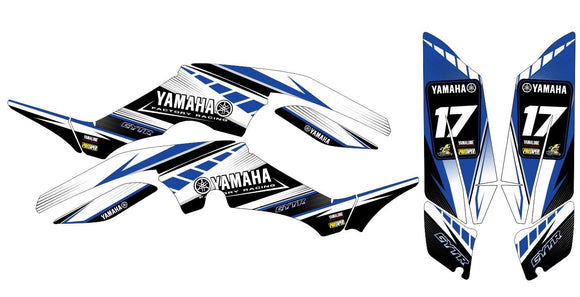
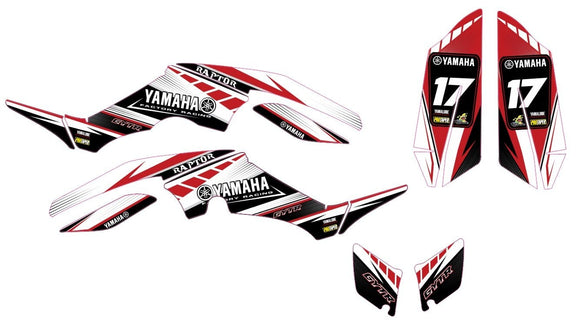
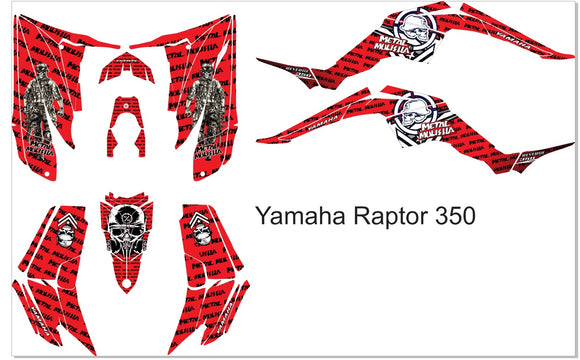
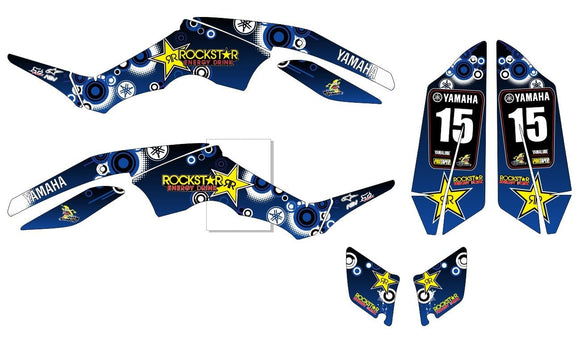
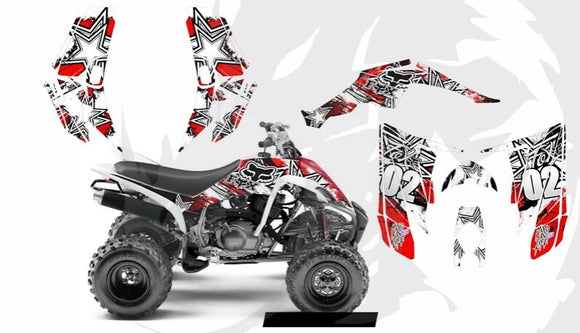
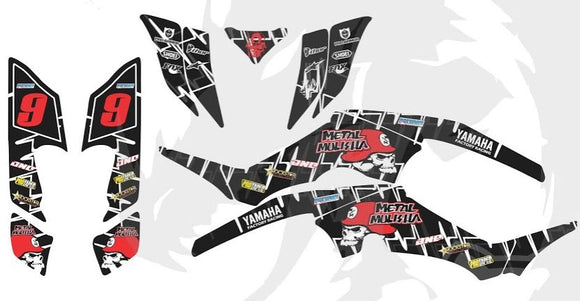
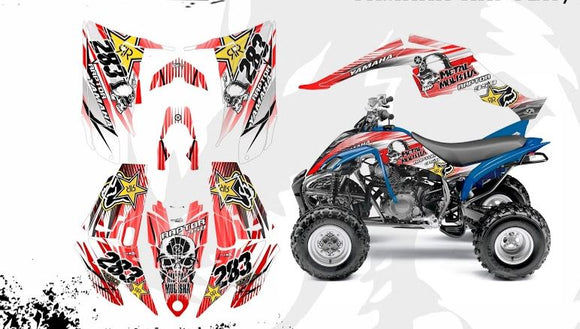
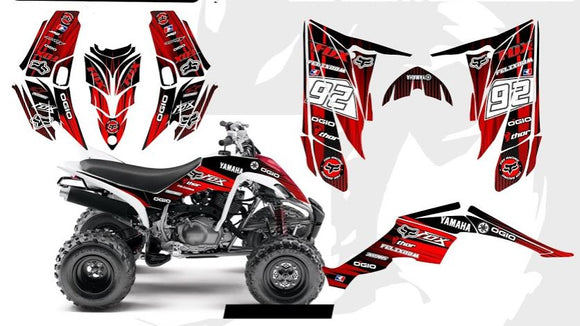
Yamaha Raptor 350 ATV Graphics
RAPTOR 350// Graphics & Decal Kits
2004 · 2005 · 2006 · 2007 · 2008 · 2009 · 2010 · 2011 · 2012 · 2013
The complete Yamaha Raptor 350 graphics catalog — every model year 2004 through 2013, every plastic panel covered. Precision-cut laminated cast vinyl, panel-matched to the Raptor 350 chassis, built to survive trail mud, dune sun, and track abuse while transforming faded factory plastics into a sport quad with real visual identity.
Every piece cut to the exact panel geometry of the Yamaha Raptor 350 — front fenders, hood, tank, side panels, rear fenders. Verified dimensions, not approximations.
Premium laminated cast vinyl with UV-stable pigments. Survives mud, sand blast, fuel spills, rock spray, and sun exposure without cracking, lifting, or fading.
Original KrazyGraphics designs. No resale, no redistribution, no sharing. Protected intellectual property.
Stock Raptor 350 designs ship in 24-48 hours. Fully custom designs in about 10 business days. Every kit made to order in the USA.
Raptor 350 Graphics Guide · Model History · Fitment Docs
The Complete Yamaha Raptor 350 Graphics Catalog
The KrazyGraphics Yamaha Raptor 350 graphics library is built specifically for the Yamaha YFM350R Raptor sport ATV — the entry-level Raptor that ran from 2004 through 2013 and became one of the most popular mid-displacement sport quads ever produced. Every model year is covered with precision-cut graphics designed around the actual panel geometry of the machine. No generic "fits most ATVs" outlines stretched to look Raptor-specific. Every kit in this catalog is cut to the YFM350R plastics you actually own, with verified fitment across the full 2004-2013 production range.
The Raptor 350 was Yamaha's answer for riders who wanted real Raptor styling and chassis design without the price tag of the 660 or 700. It hit the sport ATV market in 2004 with a 348cc air-cooled single, a five-speed manual with reverse, and bodywork that mirrored the bigger Raptor's aggressive lines at a smaller scale. Riders bought them by the tens of thousands, and they're still a fixture at trailheads, dune events, and beginner motocross tracks more than a decade after the last one rolled off the line.
That long production run and massive owner base is exactly why the Yamaha Raptor 350 graphics market stays alive year after year. Riders aren't buying Raptor 350 graphics for new machines — they're buying them for quads that are now 12 to 22 years old, with sun-faded plastics, worn factory stickers, and the cumulative scuffs of a decade of riding. A fresh graphics kit takes a tired-looking Raptor and makes it look like a fresh build. That's the entire value proposition.
Yamaha Raptor 350 Platform — 2004 to 2013
Yamaha launched the YFM350R Raptor in 2004 as a mid-tier sport quad slotted between the Raptor 250 and the Raptor 660. The platform used a 348cc SOHC two-valve single, a manual five-speed with reverse, an electric starter, and Yamaha's reverse-selector system — a meaningful upgrade over older sport quads that didn't include reverse at all. The chassis was built around the same general geometry as the bigger Raptors, with adjustable preload front and rear shocks, hydraulic disc brakes up front, a sealed rear drum, and Maxxis tires from the factory.
What matters for graphics fitment: the bodywork stayed remarkably consistent across the entire 2004-2013 production run. Yamaha didn't redesign the plastics mid-cycle. A 2004 Raptor 350 takes the same graphics layout as a 2013 Raptor 350. Front fenders, hood, headlight pod, fuel tank shrouds, side panels, and rear fenders all share the same panel templates across the model years. That's a huge advantage for the aftermarket — one set of cut templates fits every Raptor 350 ever built.
This consistency also makes the Raptor 350 one of the most predictable platforms to wrap. Other sport ATVs got mid-cycle bodywork refreshes that broke graphics fitment. The Raptor 350 didn't. Whether you have an early 2004 model or a final-year 2013 unit, our Raptor 350 graphics kits drop right in.
Why Riders Wrap a Yamaha Raptor 350
The Raptor 350 is a sport quad, but more importantly it's an aging sport quad. The newest one Yamaha ever built is over a decade old. The oldest one is pushing 22 years. That means every Raptor 350 on the trail today has been through years of UV, wash cycles, mud rides, dune trips, scuff marks, and general wear. Even bikes that mechanically run flawlessly often look tired — and that's where graphics earn their place.
Cover faded and damaged plastics
Sun-faded plastics are the number one reason Raptor 350 owners order graphics. Yamaha's factory plastics held color reasonably well, but a decade-plus of UV exposure dulls every original color into something flat and washed out. A vinyl wrap with proper laminate doesn't just hide faded plastic — it covers it completely, replacing the dull factory finish with a fresh, color-saturated graphics layout that makes the quad look new again.
Same applies to scratches, scuffs, and minor surface damage. Branch marks, tip-over scuffs, scrape marks from boots and gear, and the cumulative road rash of trail life all get covered by a properly installed graphics kit. Deep cracks need actual plastic replacement, but for the kind of cosmetic wear that builds up on any used quad, vinyl is the cheapest visual restoration available.
Restore worn factory stickers
The factory Yamaha stickers on the 2004-2013 Raptor 350 weren't built to last 20 years. By now, most original Raptor 350 stickers are peeling, faded, cracked, or completely missing. A new graphics kit replaces the entire sticker set with a coordinated full-bike design that looks intentional rather than half-decayed.
Build a more aggressive look
Some riders aren't just covering wear — they're actively trying to make their Raptor 350 look meaner than the factory ever did. A high-contrast graphics kit with bold color blocking and sharp angled accents transforms the visual character of the quad. Even owners who keep their Raptor 350 mechanically stock can completely change how the bike reads at the trailhead with the right design.
Prep for resale
A Raptor 350 with fresh graphics on top of original plastics presents better than a faded stock-appearance machine, and presents better in photos for online listings. Spending $150-$300 on a graphics kit on a machine you're selling for $2,500-$4,000 is one of the highest-ROI cosmetic moves available. First impressions matter, especially in Facebook Marketplace and Craigslist photos.
Match a build theme
Owners who've already invested in aftermarket wheels, a hood scoop, an exhaust, performance work, or other visual upgrades often find the factory graphics scheme starts looking out of place against the rest of the build. A coordinated graphics kit ties everything together so the quad reads as one cohesive build instead of a stock Raptor with bolt-ons.
What You Get With Every Raptor 350 Kit
Every Yamaha Raptor 350 graphics kit in this catalog ships to the same production standard. Opening the box, you should find:
- Pre-cut panels — every piece individually cut to match the Raptor 350 panels. No trimming required during install.
- Panel layout diagram — clear reference sheet showing where each piece goes on the machine, so you can pre-stage your install before peeling backing.
- Laminated cast vinyl — the actual graphics material is premium-grade cast vinyl with a clear protective laminate for abrasion and UV resistance.
- Air-release adhesive — channels engineered into the backing let trapped air escape during install, eliminating bubbles that plague cheap stickers.
- Contour-cut edges — every panel edge is precision-cut to match the Raptor 350 plastic, so finished graphics don't show visible overhang or require trimming.
- Install tips included — basic technique sheet for surface prep, panel order, and heat-gun use for tight-contour areas like the headlight pod and tank shrouds.
Who This Catalog Is For
The Raptor 350 graphics catalog serves a wide cross-section of sport ATV owners, each with slightly different priorities:
Restoration buyers
The biggest segment. Riders who picked up a used Raptor 350 — whether at a price they couldn't pass up or as a project quad for a son or daughter — and want to bring the bodywork back to looking sharp. Graphics are the cheapest visual restoration step in any project: they cover faded plastics, replace missing stickers, and give the quad a fresh appearance for a fraction of the cost of new OEM bodywork.
Trail and recreational riders
Owners who actively ride their Raptor 350 on trails, fire roads, sand tracks, and dirt loops want graphics that look good and hold up. Trail-grade laminated cast vinyl handles brush scrape, mud cleanup, and pressure washing without lifting at the edges. Aggressive design schemes also help the quad stand out in group rides where everyone's bike looks similar.
Dune riders
Glamis, Dumont Dunes, Silver Lake, Little Sahara, Oceano, and Pismo all see Raptor 350s on a regular basis. Dune riding is hard on graphics — sustained UV exposure, fine sand blast, and heat cycling all stress the vinyl. Quality cast vinyl with proper laminate handles dune use without chalking or fading. Bright, high-contrast schemes also help the quad show up clearly in open dune terrain for safety and visibility.
Track and motocross riders
The Raptor 350 has long been a popular entry-level quad for sport ATV motocross. Track riders want graphics that mimic factory race team liveries with number plate areas, sponsor zones, and bold color schemes that read clearly at speed. A racing-style graphics kit also helps the quad photograph better for race-day social media.
Kids and youth riders
The Raptor 350 sits at a popular displacement for older kids and teen riders moving up from a 90 or 250. Graphics are one of the easiest ways to let a younger rider personalize their machine — pick a color scheme they like, install it together as a project, and the quad becomes their machine instead of a hand-me-down. Plenty of Raptor 350 graphics buyers are parents wrapping a quad for their kid.
Raptor 350 Install Overview
Most Yamaha Raptor 350 graphics kits are designed for owner self-install. The process takes about 60-90 minutes with basic supplies:
- Clean each panel thoroughly with isopropyl alcohol (70% or higher) to strip wax, oils, and residue. This is the single biggest factor in long-term adhesion. Old Raptor 350 plastics often have years of armor-all, polish, or detailer residue baked in — the alcohol wipe is non-negotiable.
- For best results, pull the plastics off the quad before applying graphics. The Raptor 350's bodywork comes off with basic hand tools, and applying graphics on a flat workbench is dramatically easier than working around the chassis.
- Lay out all kit pieces using the included panel diagram before peeling any backing. Knowing where everything goes prevents misalignment.
- Start with the largest, flattest panel first — typically the front fenders or rear fenders. This builds installer confidence before tackling tighter pieces like the headlight pod or tank shrouds.
- Work outward from the center of each panel with a felt-edge squeegee, pushing air toward the edges through the air-release channels.
- Use a heat gun on low for tight curves around the headlight pod, tank shroud transitions, and side panel cutouts. Light, controlled warmth — not blast-furnace heat — softens the vinyl for contour conforming.
- Trim any overhang at panel edges with a fresh precision blade, cutting carefully to avoid scoring the factory plastic beneath.
- Post-install: avoid washing for 48 hours so the adhesive fully cures. After that, hand-wash with mild soap and water.
For riders who prefer pro installation, any reputable vinyl wrap or vehicle graphics shop will handle a Raptor 350 kit in 2-3 shop hours at standard install rates. KrazyGraphics doesn't install kits directly — we produce the graphics, you or your installer handles the application.
Care and Longevity
A properly installed laminated cast vinyl wrap on a Yamaha Raptor 350 holds up for multiple seasons of real use — including trail riding, dune running, and track work — without cracking, lifting, or significant color shift. Longevity depends heavily on care and storage:
Washing
Hand wash with mild soap and soft sponges or microfiber. Avoid harsh degreasers, acidic wheel cleaners, and heavy solvents. Pressure washing is acceptable at moderate distance (18+ inches) and lower PSI settings — do not use a concentrated stream directly on graphics edges, as high-pressure water can lift vinyl over time.
Storage
Covered or garage storage out of direct sun dramatically extends graphics life. UV exposure is the primary fade factor on any vinyl wrap, and a Raptor 350 that lives in the driveway uncovered will show fade faster than one that's parked under a roof. For riders in high-UV regions (Arizona, Nevada, Utah, Florida, desert Southwest), a basic ATV cover during storage is worth every dollar.
Touch-ups and spot repair
Small scuffs, scrapes, or rock-damage punctures to a graphics panel can often be spot-repaired rather than requiring full panel replacement. If you damage a single piece on your Raptor 350 kit, contact KrazyGraphics for single-panel replacements rather than replacing the whole kit. This is one of the financial advantages of a vinyl wrap versus a full repaint or new OEM plastics.
Fitment — Picking the Right Raptor 350 Kit
The Raptor 350 makes fitment easy because Yamaha kept the bodywork consistent across the full production run. That said, there are a few things to confirm before ordering:
- Confirm model — make sure your machine is a Raptor 350 (YFM350R), not a Raptor 250, Raptor 660, Raptor 700, Wolverine, Warrior, or other Yamaha sport ATV. The Raptor 350 plastic templates do not interchange with the other Raptor models.
- Year range — Raptor 350 production ran from 2004 through 2013. Our kits cover every year in that range with the same templates.
- Plastic condition — graphics adhere best to plastics that are intact and reasonably clean. Severely cracked or warped plastics may not hold the wrap properly. For best results, replace badly damaged panels before installing graphics.
- Aftermarket plastics — if you've replaced your Raptor 350 plastics with aftermarket panels, check that they match OEM Yamaha shape. Most reputable aftermarket plastic brands do, but some economy replacements have slightly different contours.
Check the product page on the specific kit you're considering — layout images show exactly which panels are included, and every kit listing specifies which years it's cut for. For unusual configurations or custom requirements not matched by a standard kit, use the custom design request option and we'll build a panel set specific to your machine.
The KrazyGraphics Difference
There are a handful of aftermarket graphics brands that sell Raptor 350 kits. The KrazyGraphics catalog stands apart on three practical fronts. First, panel accuracy — every kit is cut to the actual Raptor 350 panel geometry, not generic ATV outlines. Sport quad graphics are notoriously prone to "close enough" template work that produces visible overhang, gaps at seams, and misalignment. KrazyGraphics Raptor 350 kits fit the bike they name.
Second, trail-grade material. Not every ATV graphics brand uses laminated cast vinyl — many use cheaper calendered vinyl that saves cost but fails earlier under real trail use. KrazyGraphics uses premium cast vinyl with a protective laminate layer on every Raptor 350 kit because the machines they go on see genuine abuse, not showroom use.
Third, active design refresh. The Raptor 350 catalog gets new designs added regularly, including factory-replica-inspired liveries, race team-style schemes, trail-themed camo variants, and pure custom aesthetic work. This isn't a static five-design catalog that hasn't seen an update in a decade. It's a living library for Raptor 350 owners who want fresh design options that match their machine and ride style.
Raptor 350 Graphics for Specific Terrain and Ride Styles
Not every Raptor 350 is used the same way. The graphics package that makes sense for a Glamis dune runner is different from what makes sense for a Pennsylvania trail rider or a Florida sand pit machine. The KrazyGraphics catalog includes design schemes tuned to specific ride-style communities and terrain types.
Desert and dune running
Glamis, Dumont Dunes, Little Sahara, Silver Lake, Oceano, and the open desert of Nevada and Arizona demand graphics with high contrast against open sky and bright terrain. Lime, orange, neon-saturated, and Yamaha-blue saturation schemes all show up clearly from a distance — useful for group-ride safety and for looking good in the inevitable GoPro footage. Desert schemes also need to survive sustained UV exposure without chalking, which is why we spec UV-stable pigments across the entire catalog.
Trail and woods riding
Hatfield-McCoy in West Virginia, Windrock in Tennessee, Royal Blue, the Hot Springs ORV system, and the broader Appalachian trail network put graphics through different stress: branch scrape, sustained mud immersion, water crossings, and humidity. Wrap adhesion in these conditions depends heavily on correct install prep, but the material itself holds up fine. Trail-friendly graphics schemes often feature darker base colors that don't obviously show stain between trips.
Track and quad motocross
The Raptor 350 is a popular track quad because the displacement keeps the bike accessible while still letting riders develop real ATV motocross technique. Track-focused graphics tend toward bold race-team-style liveries with clear number plate placement, sponsor decal real estate, and aggressive angled graphics that read clearly at speed. Factory-replica-inspired schemes from Yamaha racing eras are among the most requested designs.
Florida sand and southeastern riding
Florida's sand pits, Croom Motorcycle Area, the Goethe State Forest, and the broader southeastern ATV scene put Raptor 350s through humid sun, fine sand exposure, and frequent water riding. Quality laminated cast vinyl handles all of this. Brighter color palettes are popular here both for visibility in pine-shaded trails and for the general aesthetic of southern beach-quad culture.
Northeastern trail and snow
New England, the Catskills, the Adirondacks, and the broader northeastern trail network use Raptor 350s in colder conditions, on rocky technical trails, and through occasional snow runs. Cold weather doesn't damage properly cured vinyl, but install temperature matters — never apply graphics below 60°F or the adhesive won't bond correctly. Wait for warm garage temps or springtime install windows.
Raptor 350 Vs. The Mid-Sport ATV Competition
The Raptor 350 competed against the Honda TRX400EX and TRX450R, the Suzuki LT-Z400, the Kawasaki KFX400 and KFX450R, and Yamaha's own Warrior 350. What set the Raptor 350 apart for graphics purposes wasn't just its sales numbers — it was the specific bodywork design that Yamaha chose. The Raptor 350 has clean, relatively flat panels with manageable curves: a large front fender, a defined fuel tank shroud, side panels with usable graphic real estate, and rear fenders that take big design elements well.
Compare this to compound-curve sport quads with chopped-up bodywork that interrupts visual flow, and the Raptor 350 stands out as a great canvas for bold designs. Big panels show off large graphics, gradients, and high-contrast color blocks better than chopped-up surfaces with vents and cuts. A well-designed Raptor 350 wrap goes on faster, cleaner, and stays put longer than the equivalent kit on a more sculpturally complex sport ATV.
Protecting Your Investment
A clean Raptor 350 in good mechanical and cosmetic condition holds value well. Used market pricing for a well-maintained Raptor 350 typically runs $2,500-$4,500 depending on year, condition, and aftermarket additions. Treating the bike like an asset rather than a disposable toy pays off when you eventually sell or upgrade. Vinyl graphics protect the factory plastics underneath while letting you run whatever aesthetic you want for however long you own the machine.
When you pull a vinyl wrap off a properly cared-for Raptor 350 — whether you're selling, upgrading, or just want a new look — the factory plastic beneath is typically in original condition. That matters at resale. A Raptor 350 with clean plastics under a pulled wrap commands the same used price as a stock-appearance machine, sometimes more because the buyer gets to run the factory look without paying for new OEM panels to replace scraped-up originals.
Compare that to a repaint or a set of custom-painted replacement plastics — neither gives you the same flexibility. A wrap is reversible; paint is not. If you change your mind on a color scheme two years into ownership, you pull the old wrap and install a new one. That option simply doesn't exist with paint without massive additional cost.
Start Wrapping
Browse the Raptor 350 catalog above — every design is listed with the fitment details and panel coverage so you can confirm before checkout. Stock designs ship in 24-48 hours. Fully custom Raptor 350 designs take about 10 business days from order to ship. If you need something not in the current catalog, start a custom design request and we'll build a one-off kit specific to your machine and vision.
Yamaha Raptor 350 graphics · Yamaha Raptor 350 decals · Raptor 350 wrap kit · Yamaha YFM350R graphics · Yamaha sport ATV graphics · Raptor 350 plastic graphics · Raptor 350 sticker kit · Raptor 350 aftermarket graphics · Raptor 350 race graphics · Raptor 350 trail graphics · Raptor 350 vinyl decals · Raptor 350 custom graphics · Raptor 350 OEM replacement graphics · Raptor 350 hood decals · Raptor 350 fender graphics · Raptor 350 tank graphics · Raptor 350 number plate graphics · 2004 Raptor 350 graphics · 2005 Raptor 350 graphics · 2006 Raptor 350 graphics · 2007 Raptor 350 graphics · 2008 Raptor 350 graphics · 2009 Raptor 350 graphics · 2010 Raptor 350 graphics · 2011 Raptor 350 graphics · 2012 Raptor 350 graphics · 2013 Raptor 350 graphics · Raptor 350 dune graphics · Raptor 350 motocross graphics · Raptor 350 camo wrap · Raptor 350 laminated vinyl · Raptor 350 precision cut graphics · Yamaha sport quad decals · Raptor 350 Glamis wrap · Raptor 350 Dumont graphics · Raptor 350 Hatfield McCoy wrap · Yamaha quad graphics · YFM350R decals · YFM350R wrap · Yamaha 350 ATV graphics · Raptor 350 hunting camo · Raptor 350 youth graphics · Raptor 350 race team graphics · Raptor 350 factory replica wrap · Raptor 350 restoration graphics · sport ATV graphics kit · ATV decal replacement · Yamaha ATV vinyl wrap · Raptor 350 made to order graphics · Raptor 350 holographic chrome · Raptor 350 metal flake wrap
FAQ · Raptor 350 Graphics
Will these fit all Raptor 350 years?
Yes — every production year from 2004 through 2013. The Raptor 350 plastics stayed consistent across the full model run, so a single kit fits all years.
What material?
Premium laminated cast vinyl. UV-stable pigments, protective laminate, air-release adhesive. Trail-grade durability.
Pre-cut or do I trim?
Pre-cut to the exact Raptor 350 plastics. No trimming needed during install.
Can I install it myself?
Yes. Owner self-install takes about 60-90 minutes with isopropyl alcohol, a squeegee, and a heat gun for tight curves. Pulling the plastics off the quad makes the install dramatically easier.
How long does it last outdoors?
Multiple seasons of real trail, dune, and track use when properly installed. Covered storage extends lifespan further.
Will it hide faded or scratched plastics?
Yes — that's one of the most common reasons riders order Raptor 350 graphics. Vinyl covers minor surface damage and gives the machine a fresh, clean appearance.
Does this fit Raptor 250, 660, or 700?
No. Each Raptor displacement has its own specific panel templates. This catalog is for the Yamaha YFM350R Raptor 350 only — 2004 through 2013.
Returns?
Made-to-order kits are non-refundable once production starts. Damaged or misprinted kits are replaced at no charge.
Lead time?
Stock designs ship in 24-48 hours. Fully custom designs take about 10 business days.